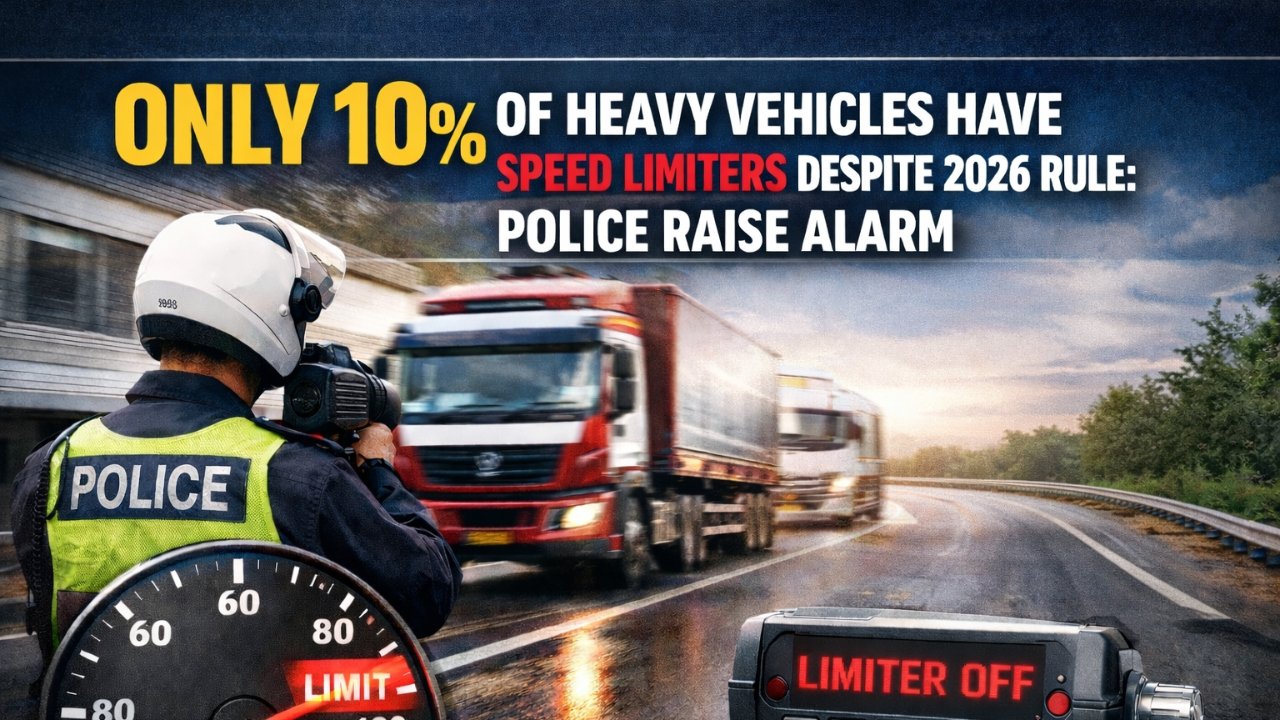
Singapore has always been known for its well-organized roads, but new evidence has come to light that counters that reputation. Only 10% of heavy vehicles (trucks, buses, and lorries) have fitment of speed limiters as per the 2026 law that came into place a few months ago. With such low compliance to the legislation, Police have warned that there is a higher potential for severe collisions on the congested highways, and it is considered a matter of public safety to fit these devices. With the high level of traffic congestion in the city and a rapidly expanding metropolitan area, the devices must be fitted for the protection of the public.
The 2026 Speed Limiter Mandate
Amendments to the Road Traffic Act allows for the 2026 rule, which states any heavy goods vehicles that are over 3.5 tonnes as well as public buses, must have speed limiters fitted that electronically restrict the vehicles to 90kph. This type of legislation is an attempt to limit reckless driving and has been influenced by the driving standards in place in the European Union and Australia. Police statistics have shown that last year 15% of heavy vehicles in fatal accidents were driving over the limit. During the initial stages of the rule’s proposal, it was stated by the Transport Minister that the initial fine for non-compliance would be set at 5,000 dollars and the vehicle would be impounded for repeat offenders. It is well known that enforcement teams have been met with non-compliance.
Impressive achievement sparks concern
Police inspections of some major depots like Tuas and Woodlands revealed a shocking compliance figure of 10%. After conducting spot inspections of over 2000 vehicles in Q1 2026, they found that only 1 out of every 10 vehicles was in possession of a fitted and calibrated device. Industry insiders cite existing retrofit costs of between S$2000 to S$4000 and a qualified technician shortage. Ravi Kumar, a fleet manager with 20 years in logistics, explains, “Many operators see it as an unnecessary expense when deadlines loom.” The Land Transport Authority (LTA) has provided a grace period of 6 months, however, that time has since expired, leaving thousands defenseless to penalties.
The Importance of Speed Limiters in Singapore
The dominant vehicles in this trade hub are heavy vehicles plain and simple. Be it electronics, perishables or any other cargo, these vehicles must travel the entire 1,600 km of road network over and over again, even daily. Without limiters, these heavy vehicles are able to travel at 100-120 km/h. This means that even minor collisions would become catastrophic. Research done by the Nanyang Technological University in 2026 found that 40 percent of heavy vehicles involved in an accident were due to the vehicles’ speed. In addition, the time it takes to stop a vehicle increases by 30 percent at higher speeds. A real life example of this is the PIE pile-up with a speeding cement mixer that injured 12 people and caused an hours long traffic jam. The use of limiters would save lives and reduce fuel consumption by 5% and would lower Singapore’s emissions in line with the Green Plan 2030.
Statistics Regarding Crashes Involving Heavy Vehicles in 2024 and 2025
| Year | Total Incidents | Speed-Related (%) | Fatalities | Vehicles Checked |
|---|---|---|---|---|
| 2024 | 1,248 | 38% | 22 | N/A |
| 2025 | 1,356 | 42% | 28 | 5,200 |
The Singapore Police Force defines speed related crashes as crashes in which 1 or more vehicles exceeded the posted speed limit by 20 kilometers per hour or more.
Police and LTA Increase Efforts to Ensure Compliance
Starting in April, police and LTA will increase their efforts to detect and penalize non-compliant vehicles. In fact, police have said they will begin daily enforcement in certain areas of the city, such as our industrial parks. At a recent press conference, Assistant Commissioner Lee Wei Ming, reminded everyone that human lives are at further risk, because of non-compliant vehicles. LTA will begin using a new reporting portal for the [removal of compliance-technology] as well as apply for a fine-discount. Contracts are also being subsidized by the LTA to cover 50% of the contract value for smaller-operating fleets, as they remain unresponsive to compliance. Experts believe that the implementation and enforcement of the S$10,000 fine will be the first factors that stimulate a compliance-technology response in the market.
Barriers to Compliance
Older vehicles will require further investment to remain operational (engine modifications) in order to remain compliant, as well as, an automated governing-system. Due to the global shortage of microchips, activists and the SLA are approaching the gov. yet again, requesting a tax-rebate- incentive for this industry as well. Singapore had been anticipating this regulation, and Malaysia had been a model of compliance. 70% of the vehicles in that country had been compliant, and as a result, a reduction of 25% of the transport-related incidents on their highways. Forewarned is forearmed, as the SLA and activists are anticipating a greater reduction of fatalities on Singaporean highways in general. If this compliance system is in place for Singapore by the end of this year, it will be a crossroad to prevent this end for many transport-related fatalities. As the police said, non-compliance is being actively deadly. The SLA and activists are anticipating non-compliance for this compliance system.
FAQs
Q. What is the start date for the compliance-technology roll out in Singapore? \n
A. For all vehicles greater than 3.5 tonnes, the date is January 2026.
Q. What penalties will be in place for non-compliance to this system?\n
A. The penalties will be fines starting at S$5,000 and increasing to the impoundment of the vehicle, repeat fines included.
Q. Are subsidies available to assist operators in imposing com0p0liance technologies on their fleets?\n
A. Yes, the subsidies are available and will reduce the out-of-pocket expenses to the operators by 50% for smaller-operating fleets offered by the LTA.