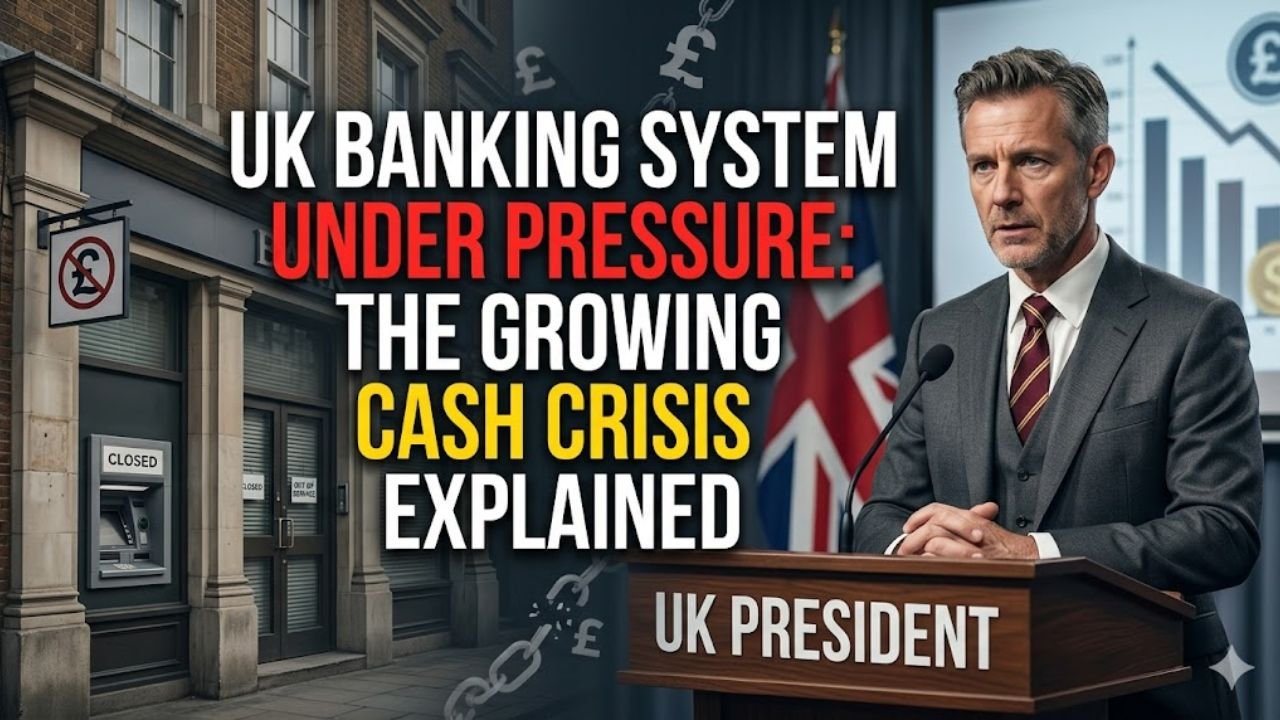
With the rise of contactless technology, the UK is going through unprecedented changes on its high streets. The UK is at an inflection point as we enter 2026. The UK is at an inflection point with the greatest merging of the digital and the physical worlds. The government and the banks have preferred the “cashless” way for years. Because of the rapid loss of bank branches and ATMs, the UK is experiencing the Great Cash Crisis. Accessible and spendable cash is increasingly becoming a right that is not guaranteed. This is especially true for the elderly and those domiciled in outlying rural areas. Losing cash access is an inconvenience. This loss symbolizes a more severe problem in the UK economy. Losing cash access is an inconvenience, and it is a disruptive problem. Losing cash access symbolizes the severe social problem in the UK and is a severe problem in the economy and a severe problem in the access problem and the financial access problem. Losing cash access is an inconvenience. It is a severe problem. Losing cash access is a severe problem. Losing cash access is a severe problem.
The Rapid Closure of Traditional Banking Services
In the past ten years, the number of bank branches across the UK has significantly decreased, with thousands of branches shutting down for good. The most severe of these closures occurred in 2024 to 2026, where banks started to eliminate branches to cut costs from rising costs, and especially with the use of digital banking. Although there has been a trend of banks closing, there still remains a need for banking services. For a community that loses its last bank, the services lost goes beyond check deposits. It also includes banking services that allow for the community`s commerce to operate. Small business owners have to travel a great distance to deposit their bank’s daily cash income, and for some people, the absence of a bank branch means the loss a contact to assist with bank transactions that may take a lot of time and effort to figure out. The existing issues come from the fact that a lot of people have to do their banking digitally, while the system to assist people has not been developed.
The Statistics Behind The Decline
Analyzing the data related to the accessibility of cash points (ATMs) and the expense of maintaining the physical network of cash points (ATMs) is essential to understand the magnitude of the problem. The table below summarizes the last few years of banking in the UK.
| 2022 | 2026 Projected/Actuals | |
|---|---|---|
| Active Bank Branches | 5,154 | 3,200 |
| Free Cashpoint ATMs | 41,000 | 28,500 |
| Cash in Retail | 15% | 8% |
| No Local Bank Community | 1,200 | 2,150 |
The data speaks for itself. While cash use in retail continues to decline, the number of cash points (ATMs) being removed is disproportionately larger. Those who still need the ability to use cash are left with fewer alternatives every month.
Effects on Small Businesses and Vulnerable People
While some people claim that society becoming cashless is an unavoidable part of society’s evolution, this ignores the fact that there are 5 million adults in the UK that rely on cash. People on fixed budgets literally can not overspend if they can only use cash. Additionally, many small retailers are squeezed by the costs of accepting card payments. The more they have to accept card payments, the more they lose because they cannot afford to lose another customer by not accepting cards because there are no ATMs. Post offices are not a reliable method of accessing cash because they are running out of money and people, and the banking system is being strained.
Legislative Response and Banking Hubs
Because of public pressure and potential risks of financial exclusion, the Financial Conduct Authority (FCA) responded by implementing new regulations on branch closures. The most significant example of new regulations coming in 2026 is the Banking Hubs initiative. Banking Hubs are spaces on the high street where customers can access services from several different banking brands on different rotating days. Although there is promise with Banking Hubs and the UK banking system, Banking Hubs are unlikely to keep up with the velocity of branch closures. As Banking Hubs and branch closures continue to roll out, the UK banking system will rely on the success of these shared banking models becoming profitable and sustainable. If banking brands are unable to successfully integrate a physical presence within the UK economy, the removal of banking branches will result in a large economic social cost. The removal/closure of branches will also require a transformation in the Banking Hubs model where access to cash is framed as an essential public service rather than a corporate privilege. This transformation will require collaboration between the Treasury, regulators, and commercial banks.
Innovation and Freedom – The Right Balance
The United Kingdom has to make one of two choices in regards to its payment system. Either the United Kingdom is going to sap the payment system of its natural evolution and let the cash system collapse, or, the United Kingdom is going to safeguard the innovative potential of the payments system. The potential Digital Pound or Central Bank Digital Currency (CBDC) offers the potential of increased payments system efficiency and the privacy and reliability of cash. In addition, the possibility that digital systems will fail, involve some form of fraud or cyberattack, and will make cash systems or the default resilient banking system with the additional rudimentary banking system elements; From a close up modern economy perspective, the current crisis shows the otherwise modern economy is a crisis with respect to the cash economy, and that is the Most banking apps modern. The UK is no longer in the banking system, and not completing the digital system to the UK banking system leaves to no one.
FAQs
Q1 Is cash still legal tender in the UK?
Yes. Cash is legal tender. Access to physical cash will always legally be a requirement of the government.
Q2 What should I do if my local bank branch closes?
You can often complete simple banking tasks, such as making cash deposits or checking your account balance, at your local Post Office or a new community Banking Hub.
Q3 Will there be cash withdrawal fees in 2026?
There are many free ATMs. However, some independent ATMs are starting to charge fees, so it is important to find free LINK ATMs.