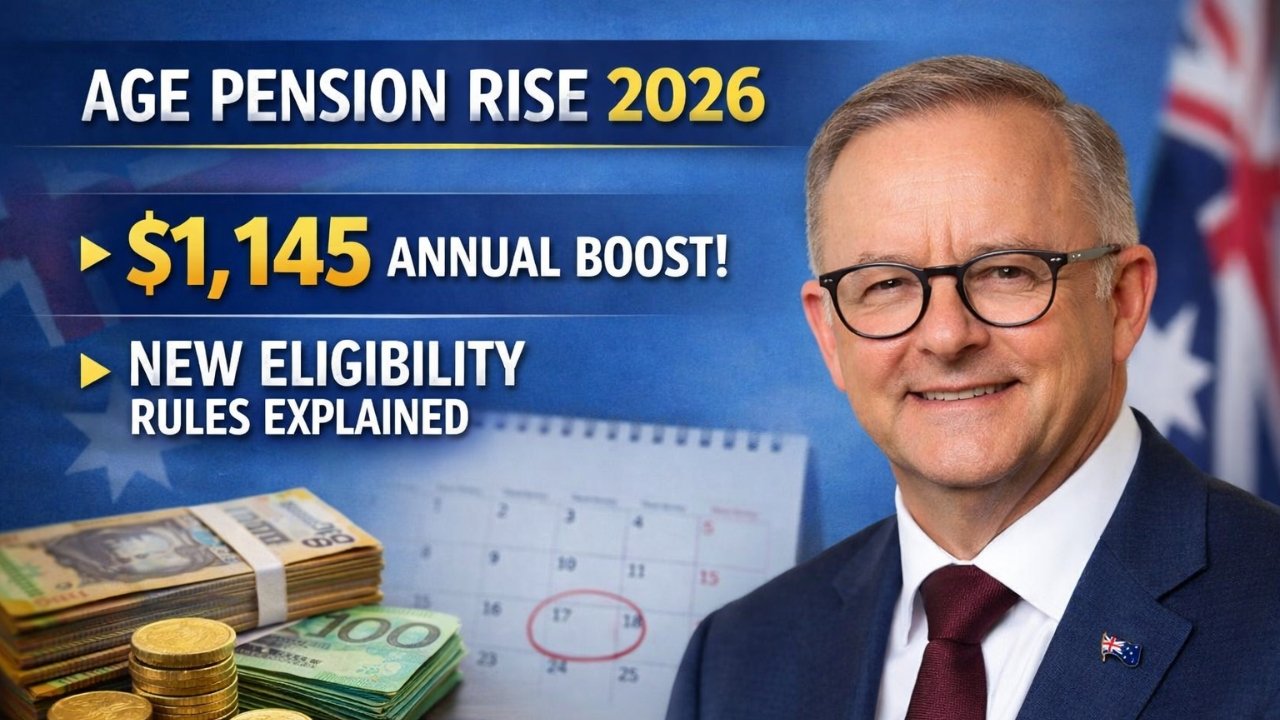
Raised costs of living are now less of a struggle for millions of Australia’s retirees thanks to the Age Pension. 2026 will see a significant adjustment of 1,145 dollars for Every recipient, since Australia’s Age Pension Australia has a sustainable built-in mechanism to adjust annually to reflect inflation, rises in the costs of living, and to give recipients financial room to breathe. This System will stay in place economically and will still function at the same level where every recipient will again receive this adjustment. This adjustment will begin to occur March 20, 2026. It is clear with the most recent data, the system is still equally giving recipients the same level of financial pressure relief.
Deciphering the increase in payment.
Single pensioners can expect a nearly 22.20 boost, and pensioner couples enjoy a cumulative increase of 33.40 or 16.70 per person. This increase is thanks to the government’s biannual analysis of the Consumer Price Index and wages which directly determines pensioner increase every 6 months. Naturally, government actuaries take the index’ output, which formulates pension increases, and adds the output to the wages index which are directly pegged to the output to keep pension payments sustainable.
While the increase does pop the financial pocket of retirees to reflect a flexible use, and ease to spend, the increase does not take the pressure off the pocket of inflation. It is a timely economic relief for retirees and the increase will be highly appreciated. Quality over inflation is always the economic sustainability principle.
Age Pension Rate Changes
From March 20, 2026, some changes are occurring for full Age Pension rates. The changes will occur until September 19, 2026. The table below provides the full Age Pension rates and is provided with the understanding that the rates do not include any supplements. The rates are based on 26 fortnights.
| Category | Fortnightly Rate | Annual Approximate |
|---|---|---|
| Single | $1,200.90 | $31,223 |
| Couple (each) | $905.20 | $23,535 |
| Couple (combined) | $1,810.40 | $47,070 |
| Couples separated (each) | $1,200.90 | $31,223 |
Pension Age Means Testing
Age, residency, and means testing create the benchmarks for Age Pension eligibility. Means testing, age, and residency are being redefined for 2026 and in a manner that prevents resource strain, yet expands the accessibility of means testing (the simplest form of means testing). The age benchmark remains 67, which is still justified for individuals born on or after January 1, 1957. That being said, there is a more pliable concept for residency in that there must be 10 years of residency in Australia, 5 of which must be consecutive (not applicable to refugees and/or those who are nationals of a country that shares a social security agreement with Australia). The most significant 2026 modification offers more flexibility for means testing as they will experience upward adjustments of the assets and income means test thresholds, which single individuals will experience a $7,500 increase and a $11,000 increase for couples, in which both are set to be determined on a fortnightly basis in addition to the income test sub limits being increased by $440 on a fortnightly basis for singles, which will aid individuals with lower superannuation or investment portfolios to access their part pension.
Changes to the deeming rates for individuals will occur based on feedback observed by financial counselors and retiree advocates who indicate that unresponsive rules have neglected eligible individuals in previous years. A practical change helping those eligible for the pension while protecting taxpayer funds is the shift toward being more inclusive with the pension rules. The changes in deeming rates will continue to be under review as they are the means used to overestimate most financial assets as opposed to low-interest economies.
Explaining Changes to Thresholds
Starting this year, there is a large increase to the upper limits for partial pensions to be claimed. For single income earners, they can now make up to approximately $4,000 per fortnight before their earnings result in the taper reduction, which is a $440 increase flush with unimportant part time work or share dividends. The income asset tests are also adjusting with the exemption of the family home and personally held items, plus the new cutoff points which reflect the regional or city property holdings of contemporary Sydney geographic centers.
From the above example, consider the retiree owning their home with a small amount of savings and an income generating rental property: they may have been previously previously fully excluding them, and now may be contributing to the adjustments. For couples this means a $66.80 increase to the fortnightly income threshold which reduces the inequities arising from jointly held finances and earnings. Financial planners note this shifting of personal circumstances which incorporate elements such as superannuation withdrawal, Australian Services gifting parameters, and other rules which can include the drawing of super earnings.
How to Get the Most Out of Your Pension
Changes to the legs of income test limits coming into effect this year means there are measures retirees can take. The measures lie shape employed are the online pension estimator available through the Australian Services website with the information on the retirement superannuation, income from asset employment, and other financial documentation, opaque. The strategic withdrawal of superannuation and or the purposeful downsizing of a means tested asset may the opened pathways to interpose for the means tests, which is an Australian Service income test and depletion rules exposure, guided by an advisors.
Local champion and advisory network assistance has been documented cost effective and is championed to those through informal support networks. The pairing of this with minimal additional rent support also means the top the captured additional rent assistance is unchanged. It is essentially in information. It is minimal and gives undue support of capturing additional support.
The Future of Planning
The changes occurring as 2026 approaches show the government is recognizing the ongoing challenges of the economy and making a positive step towards the welfare of retirees. Diversified superannuation and part-time work, for example, are better than a pension for the long term, while the $1,145 increase and relaxed rules score some immediate family pension relief. Retirees who have lived through previous indexation periods have seen these changes and have advised that building extra funds is the best approach in the better years, and this is still true today.
These are not just numbers on a page. It is about quality of life in the latter years. It is about being able to enjoy the company of family members and partake in hobbies that Australians enjoy without the stigma of constant economic worry. Given that economic thresholds are not changed until June 30, it is time to act.
FAQs
Q1: What is the exact Age Pension age?
67 for those born after January 1, 1957
Q2: How much do thresholds increase?
Singles: $7,500 in assets, $440 of income fortnightly. Couples: $11,000 in assets.
Q3: When do new rates start?
Starting March 20, 2026.